
What JW.ORG Says
We do not try to impose on others our beliefs regarding funerals. In this regard, we follow the principle: “Each of us will render an account for himself to God.” (Romans 14:12) However, if we are given the opportunity, we do try to explain our beliefs “with a mild temper and deep respect.”—1 Peter 3:15.
The Truth
Jehovah’s Witness funerals are frequently criticized by former members and non-Witness attendees for being cold and impersonal. On what basis? Hints of this are seen in the JW.ORG FAQ article under the subheading What is a Witness Funeral Like?
Service: A talk is given to comfort the bereaved by explaining what the Bible says about death and the hope of a resurrection. (John 11:25; Romans 5:12; 2 Peter 3:13) The funeral program may call to mind the good qualities of the person who died, perhaps highlighting encouraging lessons from that person’s faithful example.—2 Samuel 1:17-27.
JW.ORG (bold and italics mine)
That a funeral only “may,” “perhaps” reflect on the life of the deceased is emblematic of how emotionally detached Witness funerals can be. Of course there are countless ways of demonstrating grief and mourning the dead, but “calling to mind the good qualities of the person who died” would seem to be the bare minimum for any funeral service. Here Watchtower presents it as a “maybe.”
What Watchtower fails to mention on its official website, however, is the impersonal nature of funerals is mandated from the organization’s leadership.
Whomever gives the eulogy* at a Witness memorial service must follow the “Funeral Discourse” outline provided by Watchtower. This outline states clearly not to “overpraise the deceased.”
The purpose of the talk is to uphold Jehovah as a God of love and mercy and at the same time bring comfort to the bereaved. Give a fine witness concerning the truth, but also make your talk warm and personal. Not all points and scriptures need to be used. Adapt the material to match the circumstances of the deceased and the needs of grieving ones. While not overpraising the deceased, you may use events from his life throughout the talk to show how those in attendance can benefit from his example. Use good balance in this regard. Any use of humor should be moderate. The dignity of the occasion should be preserved
2021 Funeral Discourse Outline
The language here tells us something about what Witnesses view as “dignified.” Sharing in too much laughter spurned by happy memories, too much extolling the deceased’s value as a human being–these things could disrupt the “dignity of the occasion.” They could detract from what is stated as the purpose of the talk–“uphold[ing] Jehovah as a God of love and mercy.” Jehovah’s Witnesses believe that the greatest issue defining all of human history is Jehovah “sanctifying his name.” Thus, even at a Witness’ own funeral, she can’t risk overshadowing Jehovah.
What about after the funeral, though? A 2009 Watchtower article says the following:
True Christians see the wisdom of the Scriptural exhortation: “Better is vexation than laughter, for by the crossness of the face the heart becomes better.” (Eccl. 7:3) Moreover, they know the benefits of quietly reflecting on the shortness of life and the hope of the resurrection. Indeed, to those who have a strong personal relationship with Jehovah, ‘the day of death is better than the day of their birth.’ (Eccl. 7:1) Therefore, knowing that funeral merrymaking is associated with spiritistic beliefs and immoral activity makes it most inappropriate for true Christians to organize or even attend such celebrations. Being in company with funeral revelers would demonstrate a lack of respect for God and for the consciences of fellow worshippers of Jehovah.
“Christian Funerals—Dignified, Modest, and Pleasing to God” February 2009 Watchtower–Study Edition
Witnesses are told that grieving incorrectly can damage their relationship with God–and thus endanger their survival in the coming war of Armageddon.
…what can we do to keep ourselves separate from unclean rites and practices that can damage our relationship with Jehovah?
“Christian Funerals—Dignified, Modest, and Pleasing to God” February 2009 Watchtower–Study Edition
For a Witness to be “in good standing” in the congregation, any funeral for a dead loved one must be approved by Watchtower, even if it means eschewing familial or cultural traditions that fall outside the group’s mandates.
Regardless of their ethnic or cultural background, Jehovah’s Witnesses strictly avoid any customs associated with the belief that the dead are conscious and can influence the living. Such customs as wake keeping, funeral celebrations, funeral anniversaries, sacrifices for the dead, and widowhood rites are all unclean and displeasing to God because they are linked to the unscriptural, demonic teaching that the soul or spirit does not die. (Ezek. 18:4) True Christians “cannot be partaking of ‘the table of Jehovah’ and the table of demons,” so they do not share in these customs. (1 Cor. 10:21) They obey the command: “Separate yourselves, . . . and quit touching the unclean thing.” (2 Cor. 6:17) Taking such a stand, though, is not always easy.
“Christian Funerals—Dignified, Modest, and Pleasing to God” February 2009 Watchtower–Study Edition (bold mine)
As seen above, grieving improperly can be considered unclean, even demonic.
Because the nature of Witness funerals can be contentious for non-Witness loved ones, members are encouraged to put “their” wishes in a will long before they’re ill or dying.
Some have felt uneasy about putting such instructions into a written document. However, doing so is evidence of Christian maturity and loving concern for others. (Phil. 2:4) It is much better to set these matters straight personally than to leave the settling of such arrangements to distressed family members, who may be pressured into accepting unclean practices that the deceased neither believed in nor approved of.
“Christian Funerals—Dignified, Modest, and Pleasing to God” February 2009 Watchtower–Study Edition
Thus, Jehovah’s Witnesses are told there is only one kind of acceptable funeral; any other kind of funeral may endanger the deceased’s and their family’s relationship with Jehovah; and a member should commit to holding a funeral in this manner long before they are even dead. Naturally, in the cited Watchtower the organization paints “worldly” individuals as the ones who are likely to pressure grieving family. Meanwhile, the article goes on to say “Knowing the true condition of the dead should certainly give us the courage to conduct our funerals without any trace of worldliness.” I’ll let the reader decide who’s pressuring whom.
Given that a purpose of a funeral is ostensibly to comfort the bereaved and honor the deceased individual, it is remarkable how little of the funeral outline necessitates mentioning the deceased at all.

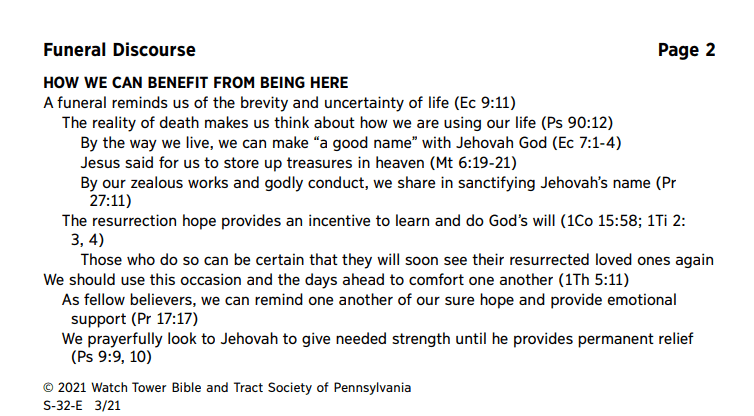
Remarks Regarding the Deceased is the shortest section of the outline, especially considering that the speaker is only to use the examples “that apply and are appropriate.” It is the only section that mentions the deceased directly. The bulk of the 30 minutes (which is the maximum length of the service, per the PLEASE NOTE section) is spent reviewing Jehovah’s Witnesses’ basic beliefs regarding the state of the dead, hope in a resurrection, and “how we can benefit from being here [in most cases ‘here’ is a Kingdom Hall].” The latter section is unusual for a memorial service–instead of ending the eulogy by reflecting on the deceased person, the speaker is directed to remind audiences that they need to “think about how [they] are using [their] life,” and that “by the way [they] live, [they] can make a good name with Jehovah God.”
Of course, one must be a Jehovah’s Witness if one even wants to begin to “make a good name with Jehovah God.” Thus, Jehovah’s Witness funerals are often criticized for being thinly-veiled recruiting tools disguised as memorial–the deceased individual, by every metric, is the least important part of the outline Watchtower requires members to use.
“Giving a good witness” to non-members is not just a hopeful side-effect of the funeral service. It is Watchtower’s stated goal. The aforementioned 2009 Watchtower, under the subheading “Let Others See the Distinction” says,
Our faithful compliance with Scriptural principles will give people the opportunity to ‘see the distinction between those serving God and those not serving him.’
“Christian Funerals—Dignified, Modest, and Pleasing to God” February 2009 Watchtower–Study Edition
The Watchtower outline for funeral talks have changed over the years, with the 1988 version saying that “giving a fine witness” [i.e. presenting JW doctrine] should be emphasized “instead of eulogizing the deceased.”
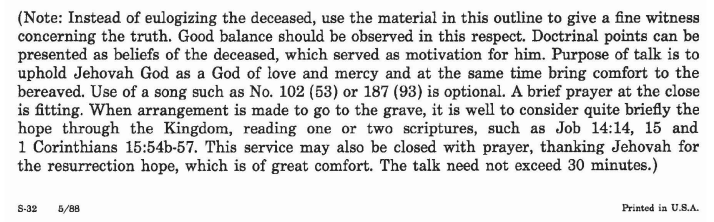
I believe this version, while not technically the most current, is the most candid, accurate description of what a Witness funeral is like in practice. While the wording has been changed in the intervening years, the funerals have not.
The funeral talk, to active JW members, may feel personal and warm, because “doctrinal points” are “presented as beliefs of the deceased, which served as motivation for him.” For example, during a recent Witness funeral I attended for a departed JW friend, the speaker transitioned to the “The Bible Gives Hope For the Dead” section by saying “Sister X believed that Jehovah is the God of wisdom, justice, love, and power.”
Thus, it does not necessarily feel to members as though the speaker is preaching instead of eulogizing–first of all, because the members are the proverbial choir, but also because it can be rationalized as the speaker giving an honest account of what the dead individual believed. After all, the most important part of any Jehovah’s Witness’ life is being a Jehovah’s Witness.
This presents problems, however. Not all Jehovah’s Witnesses do agree with all Witness doctrines–many members are “PIMO” or Physically In, Mentally Out. These individuals are trapped in the organization due to its shunning practices, which threaten to strip any member who leaves of their entire social structure. When I told my readers that this would be the subject of the next article, many PIMO readers reached out to me and expressed their fears that they would be given a JW funeral despite not believing in the doctrines. At the same time, they know expressing this fact to their JW family would get them in trouble with the elders, and possibly shunned as a result.
While the materials in the outline are said to be adaptable to fit the needs of the circumstances, when it comes to honoring the life of the human being, it is rather inflexible: the goal is to focus on what Jehovah’s Witnesses already believe, for the benefit of any non-Witnesses attending; people are more likely to fall into high control groups in times of uncertainty or personal upheaval, such as losing a friend or family member.
References to the deceased individual are to be tempered so as to not “overpraise.” The outline also forbids s spontaneous or voluntary expressions of grief or memories during the service:
Do not invite the audience to make expressions about the deceased, as this could introduce inappropriate or unscriptural elements into the program
2021 Funeral Discourse Outline
Grief is complicated, messy, and nonlinear. But Jehovah’s Witnesses pride themselves on organization and unity. They also believe converting new members is “the most important work taking place on earth today.” For Witnesses, Armageddon is imminent, and God has chosen Jehovah’s Witnesses as his people to represent him on Earth. Using one’s own funeral as a method of preaching, by this logic, is seen as an honor.
*Notes on language: Witnesses generally do not refer to a funeral service as a “memorial” service, as “the memorial” is what the group calls its annual commemoration of the death of Jesus. Nor do they typically use the word “eulogy,” instead referring to it as simply a “funeral talk.” However, for the sake of understandability to non-Witness readers, I will occasionally use these aforementioned terms in the following article]

 JW FAQ
Leave a comment